

During their last Joe Rogan appearance before their White House executive order triumph, former Texas governor Rick Perry and ibogaine evangelist W. Bryan Hubbard promoted Wendi Rees’ The Christian’s Guide to Psychedelics. The book was mentioned again in the pages of the New York Times by Andrew Jacobs, who voiced a liberal psychonaut hand-wringing postmortem on How the Trump Stole Psychedelics.1
Scripture is heavily quoted in The Christian’s Guide to Psychedelics. While I am no longer a psychonaut, I am a pastor who is also committed to Scripture. Rees and I share an appreciation for Hebrews 4:12: “The word of God is living and active and sharper than any two-edged sword, piercing until it divides soul from spirit, joints from marrow; it is able to judge the thoughts and intentions of the heart.” My sin often wants to usurp God’s power of sharp words, but we are called not to correct false teaching with malicious pride, but with truthful precision for the benefit of the listener.
So to be precise, Rees is not making merely a medical argument that Christians can undergo psychedelic medical treatments, but an argument that psychedelics can be used specifically for spiritual purposes, that is, healing through “spiritually guided journeys.”2 While science and medicine are invoked as planks, they serve as justifications for the book’s more central aim to pull psychedelic experiences increasingly into the world of evangelicalism.
Rees does this with hundreds of pages of caveats, but we return to the chorus that these are, if just “tools,” they are just “tools” that should be primarily thought of as sacred and God-ordained. In short, it is a personal testimony that does not remain just a testimony, but argues for drug-based faith healing using the words of the Bible.
(As a process note, while the book exclusively uses the slashed compound “psychedelics/plant medicines,” as someone who also used to only exclusively use those terms, here I am sometimes going to use “drugs.” I do this not as a pejorative, but to disarm unearned chemical flattery. They’re just drugs. Humans use them. Many have active ingredients found in plants. None are reviewed for approval by the Food and Psychedelic/Plant Medicine Administration. I attach no valence of slur nor glory to the term.)
As I write, Rees’ book has 28 five-star reviews on its Amazon page, with no dissent, over half of which are unverified. Several reviews praise the “updated edition” or “updated version,” which confused me, because Gov. Perry said on the early-April Rogan episode that the book was just about to be released. Apparently, this is the revised edition of the now-discontinued September 2025 version, which is a quick turnaround for a revision. Because Hubbard’s endorsement on the new Amazon page wasn’t there in September, and the cover now mentions a foreword by Perry, the timing of the new edition seems to be intended to capitalize on the Rogan publicity.
Because the book has now been promoted to millions, the serious issues with it need to be named, including but not limited to its distortion of Scripture.
Make the New Jerusalem Awake Again

The first words on the first page are quite the invocation from Americans for Ibogaine’s W. Bryan Hubbard (floating over Trump’s left shoulder above):
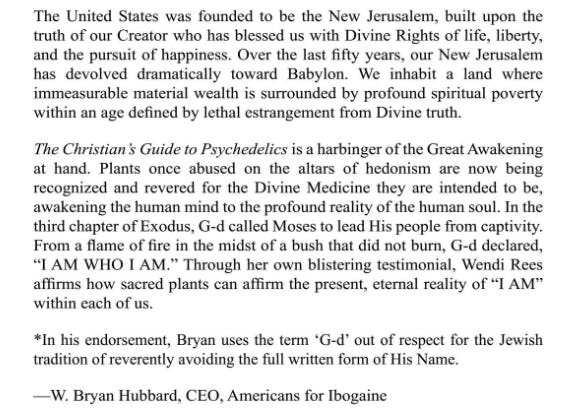
I’m straining for words here, but all I can think is that this is, literally-literally, Christian nationalism on drugs. Unlike the book it introduces, there is nothing about personal healing here, instead using the language of the Church to inject an unhinged tenor to a political vision that doesn’t signal the fruits of the spirit—love, joy, peace, patience, kindness, generosity, faithfulness, gentleness, and self-control (Gal 5:22-23)—but rather the smelling salts of the next Crusade.
The flag-plant frames the book for readers as one that is a launch, nay, a “harbinger” of the “Great Awakening” that, we are told by Hubbard, is at hand. Calling this era a “Psychedelic Renaissance” or a “New Reformation” is nothing new, but Hubbard’s shofar blast makes different assumptions about its revolutionary praxis and vision.3 The old liberal psychonauts influencing New York Times access journalism thought everyone would trip into becoming mystic Democrats, while the new psychedelic right seems to believe we may become not only healed, but biblically serious Christians, one prayerful dose at a time.
Most mainstream orthodox Christian theology views the New Jerusalem (as described in Revelation 21-22) as a vision of the “eschaton,” or The End, that is, the true end of all time and human history, not just when we got bored of democracy. The New Jerusalem is also an image of heaven, representing all nations (not a singular nation-state) joyfully and freely basking in the love of God. The New Jerusalem is not at all a place on earth, but the vision of what John of Patmos sees after our earth has passed away (Rev 21:1).
Instead, Christian nationalism makes the New Jerusalem into something we achieve. You end up where nobody wants to be, inside a William F. Buckley quote: “don’t immanentize the eschaton.” It’s an American idol that makes our cups runneth over with self-importance, remixing old hippie fantasies about “spiritualizing humanity” and saving the planet in the lingua franca of American evangelicalism.
There is also a strangely specific psychedelic historical precedent. The admirable 1960s Harvard Quaker psychonaut Licia Kuenning, née Lisa Bieberman, eventually quit the psychedelic movement after finding it full of sociopaths (I wrote about her here when I could relate). While she stopped using psychedelics, as time went on, she passionately believed she had received a prophecy that the New Jerusalem was going to occur specifically in the town of Farmington, Maine, in the year 2006. Insofar as it makes one uncomfortably wonder if this sweet woman of integrity’s prophetic lens was a downstream consequence of heavy drug use years after she stopped, the advice holds: really, don’t immanentize the psychedelic eschaton.
All this considered, Hubbard’s opening endorsement is an odd framing to introduce a book that otherwise mostly tries to stay away from politics. Instead, Rees delves into medicine, science, and theology as someone who, in honest humility, admits that she is neither a doctor, scientist, nor theologian.
This Side of the Jordan
As part of her sincerity, Rees shares a genuinely moving personal story of why she sought psychedelic treatment. Because I am being overall critical in my review, I feel weird about saying that I admire her courage to share her journey, as if she needs my approval of her sympathetic joy. She endured childhood abuse at the hands of her pastor father, and as Gov. Perry said to Rogan, this is one of the darkest evils imaginable. She also suffered a traumatic brain injury (TBI) years ago and struggled to heal from it. Based on the timeline she presents, she began psychedelic experimentation sometime after the COVID-19 pandemic. By her witness, and by the testimony of her friends, family, and others (including her therapist), she has made a turnaround where “miraculous” feels like an earned term.
She also shares the testimonies of others who, despite their original Christian misgivings, eventually sought treatment in the forbidden places. For those who worry that psychedelics may lead someone completely out of the Church, she bears witness to how biblically-rooted Christianity has become even more important for her and others, people who have walked in darkness and now see a great light.4 In some cases, they report being back in the pews and spending more time serving the poor.5 At times, it feels like we are hearing a call across the Jordan River that the promised land really is here, and don’t you want to help folks cross it?
My heart is not hardened to these stories, nor should I want it to be. I would not dare assert that God couldn’t have worked through these experiences lest I risk blaspheming the Holy Spirit. Sometimes, the devil is said to show us the bait and hide the hook—after all, we must sell our souls for something—but there appear to have been real problems here that these drugs relieved. She consistently emphasizes that any healing is ultimately from God, an unearned grace, and it is God who gets the credit for any healing, not us, and that if we are not seeking Jesus or ending up with him, then we have gone astray somewhere as Christians. This is all consonant with our shared faith.
I also appreciate that she extensively engages with the dialectic between the abilities of “tools” to benefit and harm, and it’s sincerely not a sideshow but a heavy theme throughout the book. If we are not quite wrestling with her in the present, as she has already arrived at an answer to persuade us towards, we at least hear some of what she must have wrestled with. She even mentions the slightly obscure but important story of the Nehushtan from 2 Kings 18:4, which instructs Christians that even God-ordained sources of healing can be made into an idol.6 That specific passage was also formative to me in my theological development on faith and drugs.
And when Rees says that “many Christians who come to plant medicine do so as a last resort,”7 she’s not wrong to point it out. Whatever we may think of it, even sketchy drug therapies are surely better than the final, horrible alternative. She also discusses how abysmal Christian pastoral counseling can be when dealing with suffering, citing shame-inducing examples like “maybe you need more faith” and “maybe God is teaching you something” or “you need to choose joy” or “if you really believed God’s promises, you wouldn’t feel this way.”8 Pastors should seriously consider the harm caused by these kinds of statements in our pastoral care.
The testimonies in The Christian’s Guide to Psychedelics are not simply testimonies, but serve a purpose in a book that’s something between an argument, a notebook, and a liturgy (each chapter ends with reflection questions and a prayer). It sometimes feels like it’s just offering what resolved the author’s cognitive dissonance that arose from an apparent good and a previously-held bad. But it is all sincere.
A Few Cursed Prooftexts
Scripture is obviously very important to Rees, and she has worked out her psychedelic salvation with no shortage of fear, trembling, and prooftexts. Sometimes the Scriptural references are swirling and slightly repetitive across chapters, but we are inundated with chapter-and-verse examples that make it clear she has thought and thought about this.
The book presents many interpretive issues that are beyond my ability to document exhaustively, but I will use a few examples that highlight how psychedelic mysticism distorts her biblical worldview. For the sake of conversation, I’ll quote Scripture from the same English Standard Version translation that Rees draws from.
On the second page of the first chapter, Rees cites the odd story from Matthew 21:18-19 where Jesus curses a fig tree. Per Rees:
We see in Scripture that Jesus cursed a fig tree, and it withered away, never producing fruit again (Matthew 21:18-19). God could just as easily remove Iboga, or any other plant, from the earth if He chose. That He hasn’t isn’t a command to partake, but it’s something to reflect on with gratitude. The plant’s continued existence may simply serve as a reminder that God, in His mercy, still allows access to certain gifts for those He leads down that path. (p.21)
But this passage is as much about fig trees as Ezekiel’s valley of dry bones is about a skeleton. They are both poetic stand-ins for God’s people as a whole. Here is what the passage says:
In the morning, as he was returning to the city, he became hungry. And seeing a fig tree by the wayside, he went to it and found nothing on it but only leaves. And he said to it, “May no fruit ever come from you again!” And the fig tree withered at once.
Matthew 21:18-19
What are we to make of this? In both Matthew and Mark, Jesus does this upon his entry into Jerusalem, immediately overturning tables in the Temple. This isn’t as out of place as it seems; in the Hebrew scriptures that Jesus would have read (which now make up our Old Testament), the fig tree is a poetic symbol for the spiritual state of Israel. So when he passes judgment on this ill-fated tree, he is intentionally echoing the prophets who conferred God’s judgment over Israel before his journey to the cross. At heart, it teaches us that Jesus has come to Jerusalem, the center of his religion and nation, and has found their collective spiritual state barren.
To read this passage as a passive blessing of psychedelics does not follow unless one wants to equally ask, well, why doesn’t God remove plants that we know to be purely poisonous to humans? Why does God allow any plants to be used for evil purposes? Why does God allow any evil at all?
Right after the fig tree, Rees continues her psychedelic justification by using Romans 8:19-21, which reads:
For the creation waits with eager longing for the revealing of the sons of God. For the creation was subjected to futility, not willingly, but because of him who subjected it, in hope that the creation itself will be set free from its bondage to corruption and obtain the freedom of the glory of the children of God.
Romans 8:19-21
Rees interprets it as follows:
Creation is not discarded. It’s waiting to be redeemed. God has a future for the earth, which includes healing and freedom. This is consistent with a Christian’s care and reverence for creation in the healing process. (p.21)
But like the fig tree passage, Romans has nothing to do with a theology about human interaction with creation. Yes, we are called to help steward the earth in Genesis, but in Romans, Paul is referring to the return of Christ at the end of time, when creation is fulfilled in the final work of God, who resolves every historical injustice and reveals the fullness of truth, beauty, and goodness of God’s love. In verse 18, he tells us to look beyond this world, to hold on to our hope for heaven while we suffer: “For I consider that the sufferings of this present time are not worth comparing with the glory that is to be revealed to us.” (Rom 8:18). This is what creation waits for. Instead, the book tells us that creation’s patience was waiting for more 21st-century humans to use iboga.
Immediately after this, Rees continues with an exegesis of Revelation 22:2, which reads:
…through the middle of the street of the city; also, on either side of the river, the tree of life with its twelve kinds of fruit, yielding its fruit each month. The leaves of the tree were for the healing of the nations.
Revelation 22:2
Where Rees goes with this:
This Scripture points to the endgame of God’s story, where healing and plant life are inseparably linked in His eternal Kingdom. It affirms that healing through creation is not only Biblical but also part of God’s eternal plan. From the very first chapter of the Bible (Genesis 1) to the absolute last chapter of the Bible (Revelation 22), and multiple places in between, God references plants for provision and healing. (p.22)
By this logic, three verses later may raise an uncomfortable question when it reads, “And night will be no more. They will need no light of lamp or sun, for the Lord God will be their light.” (Rev 22:5) Does this mean we are permitted to block out the sun, since God says we don’t need it?
But like Romans 8, Revelation 22 isn’t even talking about our earth. It’s part of the same New Jerusalem that Hubbard mentioned, and contrary to their readings, it is “a new heaven and a new earth, for the first heaven and the first earth had passed away” (Rev 21:1). It is a divine vision after the earth and all our pain are no more that uses the poetic language of earthly symbolism from Genesis to give us a sketch of hope. Here on this earth, Revelation 22:2 is the name of Rees’ new retreat program.
The Glaring Omission
I have to stop the chapter-and-verse rebuttal here because I found the book full of stuff like this that would be impossible to fully rebut. What’s louder, though, is a massive omission: for all the biblical references and all her cautions about drug misuse, we do not have any discussion of the single most clear and relevant biblical concept specifically cautioning about drug use, pharmakeia (φαρμακεία).
Often translated as “witchcraft” or “sorcery” and biblically associated with magic, pharmakeia means, at its etymological root, the use or administration of drugs. Why is it not plainly translated as “drug use” by modern Biblical translators? Because there is more to it than just drug use; it is not talking about using herbs for purely medicinal purposes, examples of which Rees cites. In context, pharmakeia is the use of drugs specifically for spiritual purposes. Biblical prohibitions against pharmakeia are not merely Old Testament admonitions, either. Galatians 5:16-23 is one of the more singularly-guiding passages for Christian ethics, and pharmakeia appears as “sorcery” here in the ESV translation that the book relies upon:
But I say, walk by the Spirit, and you will not gratify the desires of the flesh. For the desires of the flesh are against the Spirit, and the desires of the Spirit are against the flesh, for these are opposed to each other, to keep you from doing the things you want to do. But if you are led by the Spirit, you are not under the law. Now the works of the flesh are evident: sexual immorality, impurity, sensuality, idolatry, sorcery (pharmakeia), enmity, strife, jealousy, fits of anger, rivalries, dissensions, divisions, envy, drunkenness, orgies, and things like these. I warn you, as I warned you before, that those who do such things will not inherit the kingdom of God. But the fruit of the Spirit is love, joy, peace, patience, kindness, goodness, faithfulness, gentleness, self-control; against such things there is no law.
Galatians 5:16-23
Elsewhere in Scripture, pharmakeia is also associated with other evil practices. Three chapters before the New Jerusalem, Revelation tells us that part of the judgment against Babylon (the same Babylon which Hubbard denounced in his Christian nationalist introduction) includes pharmakeia, alongside the excessive wealth of the empire:
…and the light of a lamp will shine in you no more, and the voice of bridegroom and bride will be heard in you no more, for your merchants were the great ones of the earth, and all nations were deceived by your sorcery (pharmakeia).
Revelation 18:23
In the Bible, every association with pharmakeia, whether it be used by other nations, the people of Israel, or Christians, is uniformly negative. Again, pharmakeia restrictions do not preclude the use of drugs for strictly medical purposes. But for psychedelics, the book argues “intentional, prayer-covered, medically supported, spiritually guided journeys into the deeper places of the heart where trauma hides, where shame lives, and where Jesus longs to heal.”9 Despite invoking Jesus, who does not simply agree with our prayers if we say “in the name of” him, this is still in the behavioral category of pharmakeia. There are a number of ways a Christian psychonaut might try to deal with this stumbling block, such as not really caring what Paul, the prophets, or Revelation thought about it anyway, but this must be grappled with by any Christian, and the book either isn’t aware of it or pretends it doesn’t exist.
While there are more Scriptural issues, instead I now want to zoom out into the broader theological traditions that underlie the book’s hermeneutics.
A New Old Mysticism
The opening chapter, “A Theology of Healing and Creation,” is centered on the emphasis that “[plants] were declared good before sin entered the world.” If you are skeptical of where she’s going with this, Rees reassures you that you are right to be skeptical, and she understands the skepticism, and so what we’re going to do together, we hear, is not disabuse our skepticism, but learn how to discern together.
While there are aspects of the book’s theology that are not issues in and of themselves, we can already see where this theological train is heading. As Solomon sighed into the pages of Ecclesiastes, there is nothing new under the sun, even when it appears so. The most succinct way I can locate the book’s theology is as a novel biblical expression of naturalistic mysticism, which has a perennially fraught history within the broader Christian tree of natural theology.
While not using the word “mystic” to my recollection,10 Rees’ experience-driven theology draws on the Romantic emphasis on individualism that eventually produced not only our Ralph Waldo Emersons but the second wave of American evangelicalism in the Second Great Awakening, which continues in its emphasis on a “personal relationship with Jesus.” (For whatever it’s worth, I still believe that such a personal relationship is important.) Today’s new “Great Awakening” of psychedelic theologies, then, can be thought of as hyper-Protestant expressions of naturalistic mysticism.
Naturalistic mysticism(s) are nested within “natural theology,” an umbrella concept for any theologies formed primarily from reason, experience, and/or the world rather than primarily from Scripture. To some extent, all Christian traditions must wrestle with natural theology, for the creation itself is a revelation, and we always bring something of ourselves and the world to the Bible. There are many fruits that can come from this, and they aren’t philosophically predictable; Catholic teaching uses natural theology extensively via rationalism, but most progressive-leaning Christianities have become increasingly naturalistic in their theology via experience, which sometimes leads them to abandon Scripture altogether, or at least their traditional interpretations.
The book’s new version of naturalistic mysticism attempts to have it both ways by combining a more fundamentalist view of the Bible with psychedelic healing, yearning to conclude that they can be synthesized. But the history of naturalistic mysticism reveals cyclical issues, and not just in the “patriarchs can’t handle the divine feminine” way, but in the “maybe we should take amphetamines to thrust the Aryan race atop our natural hierarchical throne” way. As Duke University’s Christopher Coome, Ph.D, recently wrote for Compact:
If the hippies sound a bit theosophical, that is no accident. The values and lifestyles of the hippies can be traced to the German Lebensreform—or life reform—movement, a wide-ranging cultural upheaval of the nineteenth century focused on naturalism, alternative medicine, and often, running naked through the woods….Nazis and hippies, it turns out, were not as far apart as one might think. The Lebensreform movement and the theosophical community at Ascona—with their new ideas about naturalism and holism—were as influential in the development of fascism as they were in the California counterculture.
As Coome goes on to say, the broader occult and theosophical movements were directly impactful on Aleister Crowley, Aldous Huxley, and other ancestors of the psychedelic movement, whose theological influences many psychedelic Christians unwittingly inherit.11
These same currents are why the abuses of psychedelic conversion therapy were “pioneered” by 1960s hippies, only for those waters to rise again in this book, as reported by Kaleb Graves.12 To be precise, Rees says she does not endorse using these suggestibility-enhancing drugs directly in conversion therapy, but syncretizing a biblical worldview with substance-based revelations shows blueprints for those who will. Just as a conservative may reject Christian nationalism for its marriage of the Church with state power, giving theologically-motivated therapists the power to administer drugs that make you amenable to their suggested profundities should be a different kind of harbinger, even if one holds to traditional Christian sexual views.
And so in The Christian’s Guide to Psychedelics, substance-based revelations that would be at home in the occult tradition sit in constant tension with an otherwise biblical worldview. Speaking to this tension, Rees repeatedly and correctly cautions the reader against over-glorifying nature. She emphasizes “redemption” as a key theological concept, which is also key in the Reformed tradition of my Presbyterianism. In Rees’ view, while drugs can be a source of idolatry, Christ can redeem them. Along these lines, Rees repeatedly uses one of Jesus’ nicknames as “The Great Physician,” but we could endorse any number of harmful medical treatments if we simply attach Jesus’ name to them.
But where the book more deeply errs is in conflating Christ’s redeeming work of creation with confident internal revelations from drugs, even those that seem to have healed. Psychedelics are perhaps especially amenable to feeling like they offer divine revelations because of their ability to induce salience, or simulate profundity, or, plainer, to make almost anything feel really, really meaningful. Confident of Christ’s redeeming work under the influence, our participation in creation becomes no longer simply stewardship, but cultivating a kind of white-magic pharmakeia through rituals, ceremonies, and other psychedelic liturgies. We must wonder, then, if biblical prohibitions against pharmakeia are not because participants consciously did evil, but imagined themselves to be doing revelatory good.
Belden Lane, a Presbyterian minister and theologian who has written on sacred landscapes, Celtic spirituality, interreligious theology and apophatic spirituality, describes how God meets us in the fierceness of deserts, mountains, and wilderness, where creation plays a role in God’s redeeming work by removing our illusions rather than confirming our false self-images. In Ravished By Beauty, Lane draws upon John Calvin (with whom he has a love-hate relationship) for a concept of nature as the “theater of God’s glory.” Spend enough time with Lane, and you are shocked to find yourself nodding and rejoicing with Calvin that sharing in God’s natural glory of the earth is one of the main things we’re here to do. I mean, really, can I get an Amen?
But where Christian prudence treads lightly into natural mysticisms, knowing that idolatry can collapse the theater of glory, evangelical psychedelicism is overconfident in its ability to discern the difference. As I wrote about a couple of years ago, Thomas Merton, the interfaith Catholic monastic of the 20th century, repeatedly rejected psychedelic mysticism as primarily being a case of idolatrizing experience. Many a mystic careens into the ditch of believing too strongly in their experiences. Personally, I have found much more stability, clarity, and groundedness within Christ in the majority position of Christianity’s mystical tradition, which is the path of renunciation. Self-sacrifice is cruciform; Jesus did not put himself on the cross to feel closer to God. Psychedelics amplify whatever is in our conscious and unconscious contents, including our sin. Less of ourselves actually is more of Christ.
And so Scripturally-serious theologians across traditions have cyclically rebuked naturalistic theologies, including those who aren’t fundamentalists. Karl Barth famously (okay, “famously” if you are a theologian) rebuked his friend Emil Brunner’s early 20th-century natural theology in a paper he actually titled “Nein!” They had been trained as liberal theologians, as was most of the German academy at the time. But after his misgivings emerged due to liberal Christians in Germany supporting aggression in World War I, the theme remained important to Barth as he passionately rejected the natural theological roots of his German Christian contemporaries and their Nazi theologies the rest of his career. He discovered liberal natural theologies had no theological grounds to protest when its roots bore things like Nazism, the early-20th century progressive Christian celebration of eugenics that inspired it, and now the Red White and Blue New Jerusalem.
Instead, as Barth would develop in his dialectical theology between God’s “no” and “yes,” God is not something humans can attain, understand, manipulate, or subjugate for our ends, even to elicit a unitive experience, even and especially in his name (and in no small tragic irony, Barth’s own moral failings in his affair seemed to have been built on his own delusional assurance that his “experience” of romantic feelings was God’s permission for adultery).
God’s “no” is a rejection of both our means and our ends, our tools and our religion, to fully possess his divinity. God’s “no” is not the end of the story, but God says an emphatic “Yes” to everyone in mercy and love through Jesus Christ, who is sufficiently knowable for our salvation, but defies and condemns all our attempts to use him for our purposes. And so we rely on grace.
And Rees does repeatedly emphasize that one can rely only on grace and not on drugs and still use them. This might hold if this were purely a medical conversation, but the book is making an argument for Christian psychedelic “spiritually guided journeys.” And if you look at what the book is trying to do as a whole, it is claiming to grasp Christ enough to use him for novel theological ends in a realm where the author admits she doesn’t have medical expertise or theological training. So I have to wonder why drugs are even rivaling the sufficiency of grace enough to warrant the argument.
More problems with over-indexing divinity on our inner lives and faulty understanding of the world with the Bible in hand become obvious by chapter five.
The Record Scratch
If this next section is jarring, it was jarring for me to read. After chapters on creation, her story, science, and biblical discernment, we suddenly jump-cut into Rees testifying about a polysubstance drug cocktail, which she calls “The Heart Protocol”:
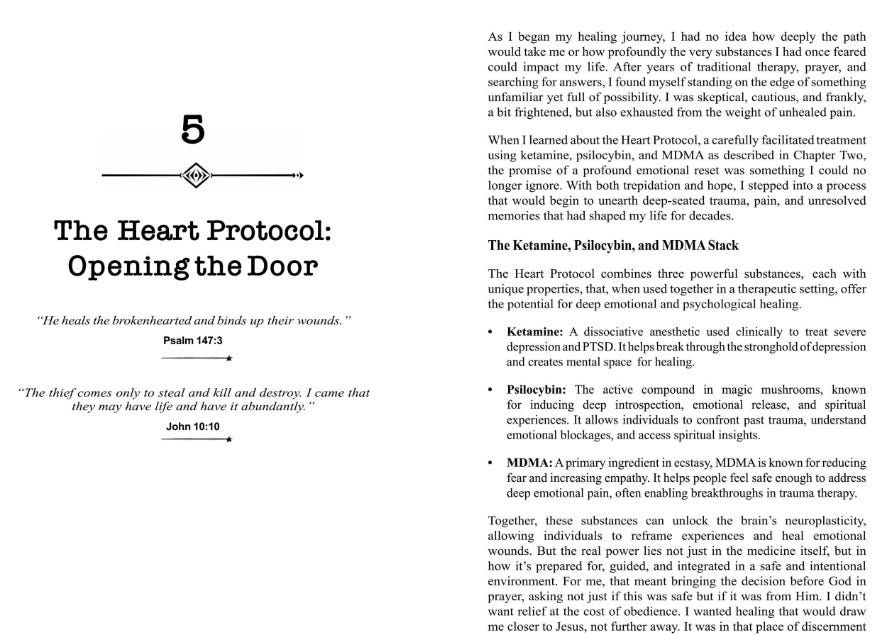
Insisting that she only took this in several supervised settings, and that she’s not really recommending it to us anyway because we should do our own discernment, she goes on to sing the praises of this combination of ketamine, psilocybin, and MDMA. This combination does not appear to have been studied in any meaningful way and is, in fact, dangerous. Having not heard of it before, my searching says it originated either from a profiteer named Samuel B. Lee or from a website that lists no names but can be contacted for a “30-minute discovery chat.”
[Follow-up on 7/16/26 — Samuel B. Lee has been charged with second-degree felony manslaughter in Florida after someone died using “the Heart Protocol” in February 2025.]
I need to be straight-up here and say it is pretty insane to see in print that what may be the thus-far most popular Christian psychedelic book, geared especially towards evangelicals, is openly promoting this cocktail. No matter how many caveats Rees invokes, this is deeply irresponsible and risks causing serious harm.
Rees tells us that this cocktail was not really the master healer, but that “the Heart Protocol” prepared her for the holier grail of ibogaine. Along the way, she takes a detour to heavily stump for W. Bryan Hubbard’s legislative initiative in Texas (“Why This Could Change Everything”) before sharing how Jesus was present in her iboga experiences.
As I read, I couldn’t help but think about what it means when we say with certainty that Jesus was absolutely present in our psychedelic experiences (I once gave such a testimony). I’ve come to think that we have to be much more agnostic about the “real presence” of Jesus in psychedelic experiences. While others may call them “sacraments” if they want, Christian sacraments affirm Christ’s presence because they are tied to particular practices of Jesus in the New Testament. For psychonauts who feel certain they encountered Jesus, I would encourage some openness: what might it mean if it was just my unconscious? Did it do harm to my mental image of Christ to attach him to psychedelic profundity? What might it mean if seeing a real-feeling image of Jesus was just what I wanted to happen? Could God work through it anyway? Could less benevolent powers do so?
Rees describes wanting a community where Jesus is at the center in the same book where she spends 200 pages centering Jesus around drugs. But while Jesus may be at the center of Rees’ life, Jesus isn’t at the center of this book. The drug experiences are the reason this book exists, around which all its other words turn. And for however some drugs can help, they can also produce distorted counterfeits of the Christ who lives, reigns, and dwells beyond experiences, because we can make glamorous idols out of those too, and evil can work through those too, and no matter how well you think you know Scripture, these are drugs that make it hard to tell the difference.
Invitations
As I was reading, I found it hard to know exactly where she stood, which kept giving me pause as I was writing this up. At times, we seem to nearly completely agree. In one of the closing chapters, she says:
“This story does not claim that healing experiences reveal spiritual truth, grant divine insight, or replace the authority of Scripture. No substance, practice, or altered state opens access to God. God alone reveals Himself, and He has done so fully and finally in Jesus Christ. Scripture remains the final authority for faith, truth, and discernment. Experiences, no matter how profound or emotionally powerful, are never self-interpreting. They must always be weighed, tested, and understood through the lens of God’s Word and the character of Christ. Healing is not the same as revelation. Relief from suffering does not equal spiritual authority. An encounter that brings freedom does not redefine truth. God heals because He is merciful, not because a method unlocks Him. If this book stirs anything in you, let it not be a desire to seek an experience, but a deeper surrender to Christ Himself. Seek obedience over intensity. Seek faithfulness over encounters. Seek the Healer, not the tools He may choose to use. The greatest healing is not found in what we experience, but in Who we belong to.” (p.218)
What I find myself wondering, then, is why so much of the book seems to contradict in practice what she says here in principle. Rees insists that all she’s doing is helping us discern, and what we read is indeed a journal of Rees’ discernment up to this point in her life on this topic. I don’t know what it’s like to have a TBI or to endure such abuse, and as I read, I felt the privilege of what I haven’t had to face. But while she emphasized that drugs weren’t the destination, she still gives them too much glory in the journey and encourages others to go and do likewise.
Part of the issue is that in the psychedelic world, the spiritual healing never ends, and it’s incentivized not to. “Healing” is often amorphous, vague, and ongoing, more so when it’s spiritual. The ascendant psychedelic industry will not be economically satisfied with a care model of minimally invasive therapeutic use. To grow, it will require convincing more people to undergo more drug treatments for more types of symptoms more often. Its social history also indicates it will not be ideologically satisfied by minimal use either, self-mythologized as part of a “Great Awakening.” I hear this book wanting to make a more limited argument than what it actually does and what it will ultimately serve.
Where Rees’ discernment could look next, in quieter places than online discourse, is reckoning with how psychedelics can mess up your very ability to discern. As I wrote in my piece on the social engineering behind the psychedelic movement:
A recent paper on this phenomenon by researchers Lucas F. Borkel et al. points to what is called the “epistemic risk.” That is, psychedelics can not only change what you believe, but how you decide what’s true. Through an inflated sense of meaning, psychedelics can impact your truth filter and BS detector, the very ability to tell between truth and counterfeit.
Setting aside drug-induced false memories and delusions of grandeur, this epistemic problem is not easily solved by just using the Bible as a test. Yes, Rees emphasizes that “Not all psychedelic/plant medicine experiences are holy, and not all spiritual insights are from the Holy Spirit.” But in my experience, it’s naive to think we can easily discern the difference when a side effect of the substances is infusing outsized importance to their “insights.”
What really tests charity, though, is how the book postures as discerning, but the rhetoric of honoring the reader’s skepticism serves as seduction. The book ends with a promotion of her retreat program. The book says the retreat will not involve drugs, but will be a place to “prepare, pray, process, and integrate” them: “This is your invitation.” However, her website now indicates retreat offerings will include ibogaine usage.13 Like much of psychedelia, and like Christianity for that matter, and like the biblical magician Simon Magus,14 this risks trying to turn the power of God into something for sale.
When Rees says “we need to walk alongside and listen and discern,” does that include the voices of the many Christians who quit using psychedelics and left the New Age? The book doesn’t engage them. Does that include the testimonies of those severely harmed by “plant medicines”? We don’t hear from them. When she says “the church needs to engage,” does that include perspectives like CatholicAnswers, or any other pastor’s or theologian’s perspectives? If so, they weren’t in the pages, neither to agree nor disagree, only appearing off-screen as generic, disembodied Pharisees.
If the only point the book made was that psychedelics are fine as medical treatments, then it would be a different book. Ultimately, this book takes joyful, if blurry data of personal healing stories, then peer-pressures the reader to agree with interpretive leaps to the extrabiblical water the author says she’s not leading us to. This book fails not because drugs have no medical benefit, but because we all know that’s not the conversation we’re really having. As Rees says, she doesn’t want purely medical interventions, she wants “spiritually guided journeys.” But the discussion doesn’t even mention the most biblically important question: is this pharmakeia? Instead, I hear the book ask, “Did God really say you must not do psychedelics?”15 But this isn’t the question. If this were a purely medical and scientific argument from Christian principles, we would not be talking about Great Awakenings, sexual conversions, and many other matters left to God.
I know Rees knows that Jesus will never abandon you. Maybe she would agree with the following: if anyone ties your relationship to Jesus so closely to experiences you had on drugs, it may feel like abandonment again to give them up. That is how psychedelic spiritual addiction functions. But Jesus Christ will be there even if our fallen New Jerusalem isn’t built, even if we suddenly one day realize our whole psychedelic endeavor isn’t what we thought it was, even when the “tools” we use to reach him betray us, because Christ will remain the same yesterday, today, and forever,16 sitting not in the ecstatic vision, but in our suffering. And as much as you may have found him in the trip, you may find him even more in the renunciation.
The healing can be celebrated. The work of the Spirit can surprise. So can our sin. “Discernment” is just a rebrand for rationalization unless it takes us to inconvenient places. My psychedelic testimony is finding that Christ survives it all, suffers it all, and sits with us all when the lamp we thought was his light has gone out.
p. 25
Brian Muraresku’s also-Rogan-enhanced The Immortality Key, which also posited questionable grand theories about the past and future of psychedelic Christianity, also stepped into the halls of power before apparently throwing the middle finger at the industry.
Isaiah 9:2
p. 200
p. 26
p. 27
p. 27
p. 25
The Kindle version is not searchable text, but images. Self-published authors, let’s not do this.
For more on psychedelics and authoritarianism, see Pace and Devenot, “Right-Wing Psychedelia: Case Studies in Cultural Plasticity and Political Pluripotency” (2021).
Let the reader understand that the 1960s psychedelic therapy vanguard did practice conversion therapy. Last year, the forefather of modern psychedelic therapy, Stan Grof, issued an open letter to address his old views before issuing a second, Monty Python-esque open letter to address the shortcomings of the first open letter.
Acts 8
The snake’s Genesis 3 question was subtly manipulative by falsely strawmanning God’s position.
Hebrews 13:8