

I. The Valley
A few months ago, I got stranded in the barren bunker that is Washington D.C.’s Dulles airport around 11pm. After getting over my embarrassing outburst at a gate worker, I called the hotline for a hotel voucher, expecting a fight to prove my humanity in the face of the injustice I had suffered. Instead, the voice on the other line met me with the composed empathy of a chaplain talking to her fourth ER patient that day. Thank God, not a robo-line. Or was it? As the conversation went on, I couldn’t ignore the slightly-too-pregnant pauses after each of my responses, or the stupidly-good calibration of tone between seriousness and lightheartedness. I wound up with a free stay at Holiday Inn, but why was my brow furrowing as I hopped in the shuttle?
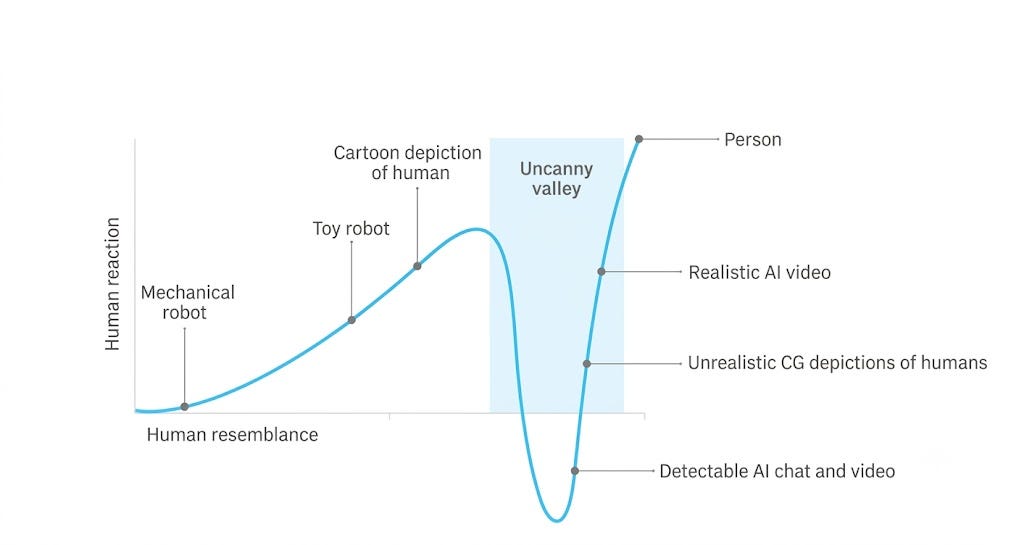
Whether with AI or politics, we all stand at different points in an uncanny valley. The Valley is an old phenomenon which records, but does not fully explain, our instinctual disgust at imitations of humanity. It is called a valley because our repugnance neither simply increases nor decreases based on how humanoid something becomes. Our comfort rises with human resemblance, then dips when something becomes close-yet-disturbingly-far from human, then rises again when it gets more fully human, as better seen in this AI-generated chart:
To those of us who have followed psychedelic drug politics, whether by choice or bad divine luck, the mild nausea of the valley is familiar. The production of psychedelic political content requires constant performances of humanity that must originate from some real referent, but can glitch upon critical eye contact. I am reminded of Eli Sunday, the charismatic frontier preacher in There Will Be Blood, who hides his power games while confronting the far more brass-tacksian oil tycoon Daniel Plainview, an egomaniac who grows in terrifying magnetism the more he stops pretending. The preacher Eli lands somewhere in the valley of our disgust, while Plainview climbs out of the valley and back into authenticity, even if brutally.
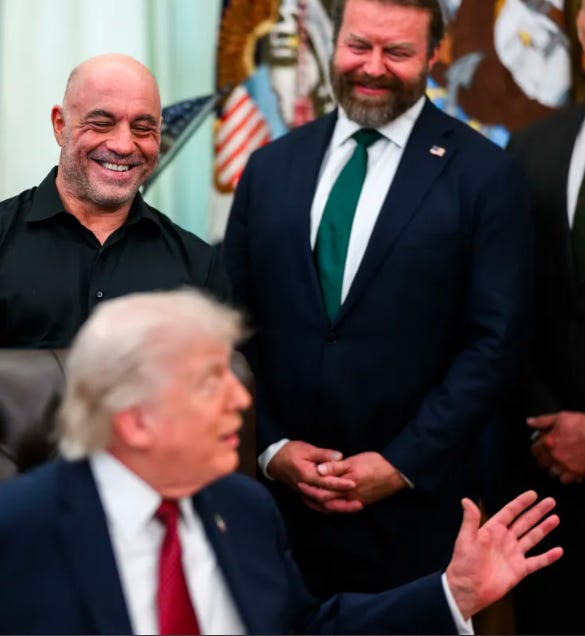
In what is the busiest year of psychedelic drug lawmaking to date, there have been few more notable forces than W. Bryan Hubbard, founder and CEO of Americans for Ibogaine (AFI). Alongside his non-profit partner, former Texas governor Rick Perry, Hubbard was crucial in the birth of Donald Trump’s April psychedelic executive order, and his organization has spearheaded a multi-state mission to fund ibogaine research in hopes of finding a better treatment for opioid addiction, often by utilizing opioid harm settlement money stewarded by state governments.
While Hubbard continues to receive positive media profiles from the psychedelic industry, which dubs him the “Republican psychedelics whisperer,” his legislative efforts faced headwinds in 2023, including reported concerns of pay-to-play conflicts detailed in outlets like the Daily Beast, with more detail in Psychedelic Alpha. Hubbard said in 2024 that the failures were due to detractors’ fealty to Big Pharma, and Americans for Ibogaine’s website links to “a pro bono open-source intelligence (OSINT) investigation examining the network of policymakers, institutions, researchers, donors, and industry stakeholders connected to the opposition.”
The media coverage of Hubbard—Southerner by nature, lawyer by nurture—all note his hypnotic Appalachian register, which carries the voice of guys who sang bass in the church I grew up in. In this parasocial universe we inhabit on the internet, hearing him talk alongside Gov. Perry in their two episodes of the Joe Rogan Experience is the closest many will ever get to sitting on a veranda porch in a rocking chair while your buddy’s buddy idly discusses everything from the bigger questions of life to the ineptitude of the Tennessee Volunteers football program, which for many of us born Southerners, remains one of the bigger questions of life. Sometimes, though, the porch relaxation vibe gets punctured; as Hubbard told one podcaster about the “divine medicine” he is on a mission for, “Any system that maintains its prohibition from human hands is one that needs to be smashed to bits.”
Growing up in Virginia as the grandson of coal miners, he wound up in law school in Kentucky before becoming jaded by the justice system.1 According to a profile by a psychedelic industry access journalist in Reason, whose parent organization has worked directly with AFI on crafting ibogaine legislation:
He learned that law often had "nothing to do" with objective truth or justice, that power frequently trumps truth, and that the legal system is regularly used by those with power to crush people who don't have any. "Our judicial system is a disgrace, period," he says.
These lessons did not immediately turn into psychedelic activism (Hubbard says he began taking psilocybin around 2018). For sixteen years, he worked as a lawyer defending Walmart, Tyson Foods, and others against workers’ compensation claims from people who had workplace accidents. As he observed, their injuries often led them into opioid addiction, and he came to see this as a spiritual disease more than anything:
One day, Hubbard was driving through town, pondering how it could be that women who were taking enough opioids to knock out a horse could still be in pain, when a thought struck him: Their physical pain was a symptom of a profound emotional and spiritual pain that no amount of pharmaceuticals could alleviate. “They had reached a point in life where they recognized that they were going to be living at the dead end of welfare subsistence to their grave, without any prospect of having a life that we would perceive as being one that is lived with freedom and dignity and control over destiny,” Hubbard says. “That work accident…was the straw that broke their backs.”
Notably, he gained this perspective not as the lawyer fighting for people in addiction, but as the lawyer whose job was minimizing the amount of injury benefits they could receive from the South’s largest corporations. As his website describes his lawyer era, “During this time, he witnessed the early stages of Kentucky’s opioid crisis, shaped by generational poverty, joblessness, and substance use.” And he often witnessed the victims of these phenomena as their opposing counsel.
As he tells it, the years of observing these rising crises drove him to work in public service, including studying the state’s Social Security disability system and running the Kentucky Attorney General’s Medicaid Fraud and Abuse Control team, eventually becoming chairman and executive director of the Kentucky Opioid Abatement Advisory Commission. But the more powerful force that seems to lead him is the pillar of fire of professed Christianity; to this day, the emphasis of Hubbard’s public faith takes from the best parts of social justice activism and grounds it in conservative grammar:
“What gets me fired up and ready to go every morning,” Hubbard says, “is perhaps thinking that there might be something within me that God finds suitable to utilize to pursue the emancipation of my fellow human beings from any subjugation that they might be suffering.”2
Because such testimonies regularly spill out when he is talking about ibogaine as a “divine medicine,” he is often likened to a preacher, and if he sometimes falls into sermonizing, these theological crimes of passion are forgiven by his allies. And I get that; take it from someone who does preach every Sunday, preachers can get carried away by a desire to share the sacred that our words are racing to catch up to. If the adage is true that every preacher is first preaching to themselves (and it is), then the sins of our verbosity often come from trying to rouse ourselves past self-doubt.
The dilemma, though, is that because Christianity is so much about a relationship with words, the battleground for souls can get distorted by the incentives of rhetoric that preachers on podcasts and in pulpits face alike. I’ve felt how aspiring to be a master rhetorician tempts you to rationalize your passions and preach what people want to hear more than what you both need to hear, and it is a perennial irony in the history of Christian homiletics that Paul the Apostle thought dimly of mixing eloquence with the message of the cross.
These complicating dynamics are hard for me to ignore when I stand in the valley between podcast preaching and political activism. And they became real this year when an ibogaine bill came to the Vermont legislature, the state where I now live.
II. Free Treatment, New Bill

When bill H.859 entered the Vermont legislature through Democrat state representative Rep. Brian Cina of Burlington, I emailed concerns about the bill’s construction to Rep. Cina and the committee.
The bill is listed on Americans for Ibogaine’s legislative tracker, and the bill’s preamble says it is explicitly an instrument of AFI’s goals: “establishing a Psychedelic Therapy Advisory Board in Vermont is a step toward Americans for Ibogaine’s goal of establishing ‘the medicalization of ibogaine in the United States.’” When I asked AFI about their role in drafting the bill, Hubbard said, “At Rep. Cina’s request, AFI reviewed and provided feedback on Rep. Cina’s bill but did not draft it.”
One of my main concerns was that the bill would divert $300k from Vermont’s opioid recovery services that, however small, make a difference in the lives of real Vermonters today; just weeks before the bill was introduced, Vermont’s Opioid Settlement Advisory Committee issued a memorandum outlining uses for the funds, which included things like recovery housing, a teen drop-in center in Barre, prison peer coaching, and EMS supplies of buprenorphine, but not new research. In describing his Kentucky bill in 2025, Hubbard argued for “set[ting] aside just a small percentage of this money to try to foster a therapeutic breakthrough for the treatment of opioid dependency.”3 But rather than make a separate case for additional funding of research, this takes away money that means far more to thin recovery services budgets than a pharmaceutical company’s, where $300k is a rounding error for clinical trial funding. It diverts money away from opioid addiction sufferers again for something that might never actually help them.
I was also concerned that the bill’s contracting requirement would have restricted funding contracts to a “Vermont entity” that must also have “entered into an ibogaine drug development and manufacturing contract with another state.” Government research grants typically involve an open, competitive process to ensure the best science gets funded. Given that Vermont’s small population means it has very few research institutions, the bill appeared to be anti-competitive to benefit a predetermined recipient.
The bill also wanted to create an advisory board that disproportionately favored the psychedelic industry by mandating that three of its ten members be people “with lived experience of benefiting from psychedelic therapy,” with no stipulations about representing people harmed by psychedelic therapy. AFI's website states a commitment to “ethical storytelling” (which asserts a value of being “transparent about the risks”).
The Free Ibogaine Treatment
I was invited to appear on Vermont Public (Vermont’s NPR) to discuss the bill, but was unable to attend. When I heard the recording of the program, it raised further red flags that something stranger was going on. At around the seven-minute mark of the Vermont Public interview, Rep. Cina shares the story of the bill (bolded for emphasis):
And then most recently I was recruited to be an Opioid Policy Fellow with the National Conference of State Legislatures. And as part of that, I traveled around the country and learned about the various upcoming approaches around the country that are considered best practices. I also looked at the strengths and assets that Vermont has and at the gaps in our system, and over the package of recommendations that would build on our strengths, fill the gaps, and implement some additional practices that have promise. And one of those is psychedelic-assisted treatment. And then as part of that fellowship, I was connected with Americans for Ibogaine, which is a national organization that worked in Texas and those other states to move forward with the consortium. And then finally, I would say that through my connection with Americans for Ibogaine, I met a doctor who offered me an Ibogaine treatment. I had been experiencing PTSD symptoms and issues with substance use, dependence, specifically nicotine and he offered me a free treatment, and I did this ibogaine treatment, and it completely reset my nervous system and I'm no longer addicted to nicotine. So I got to personally experience the benefits of ibogaine at the end of last year in December. … I had to travel to another state for it. I will say that I’ve met other Vermonters who had the treatment and they’ve had to travel out of state for it. I went to Washington state.
Vermont state Rep. Brian Cina, April 9, 2026
To summarize, just over a month after receiving a free ibogaine treatment—the typical out-of-pocket cost runs at least several thousand dollars—from a doctor he says he met “through” his connection to AFI in December 2025, Rep. Cina then introduced the bill in early February 2026 with language that directly names AFI and its goals. Rep. Cina did not return a request for comment for this story.
According to Hubbard in response to emailed questions, “AFI did not facilitate, arrange, or play any active role in connecting Rep. Cina with his ibogaine treatment provider. AFI hosted the American Ibogaine Meeting in Aspen, CO, which was attended by approximately 200 people in November of 2025. Rep. Cina attended this meeting in person. It is possible that he met the provider there. I didn’t witness the meeting and therefore can’t identify who the provider may be.”
Regardless of its origin, such a gift would appear to violate the Vermont State Code of Ethics for Rep. Cina, which prohibits public servants from accepting gifts valued at more than $50 per occasion, or more than $150 per year, from any single source.
AFI is not registered as a lobbyist, which at first I didn’t understand. The Vermont Secretary of State’s lobbying webpage defines lobbying as follows:
A. to communicate orally or in writing with any legislator or administrative official for the purpose of influencing legislative or administrative action;
B. solicitation of others to influence legislative or administrative action;
C. an attempt to obtain the goodwill of a legislator or administrative official by communications or activities with that legislator or administrative official intended ultimately to influence legislative or administrative action; or
D. activities sponsored by an employer or lobbyist on behalf of or for the benefit of the members of an interest group, if a principal purpose of the activity is to enable such members to communicate orally with one or more legislators or administrative officials for the purpose of influencing legislative or administrative action or to obtain their goodwill. - 2 V.S.A. § 261(9).
At first glance, what Rep. Cina described to Vermont Public in the crafting of bill H.859 appears to fit A, B, and C, and a lot of grey ambiguities around D. But you don’t have to register as a lobbyist if your only activity is testifying before legislative committees or providing requested information by an official, and these are the exact boundaries AFI abuts.
In a set of questions sent to Hubbard while I was learning about this, I asked, “AFI does not appear as a registered lobbyist in Vermont. Vermont law defines lobbying to include obtaining the goodwill of a legislator through activities intended to influence legislative action. Can you explain why AFI has not registered as a lobbyist in Vermont?”
Hubbard replied:
Firstly, your question asserts a description of a law without providing a citation or a link to the actual language of the law itself. Based on your description of the law, any Vermonter who has a conversation with a legislator with the intent of influencing legislation must pay and follow the process to register as a lobbyist. Do Vermonters have to pay and follow the process to become lobbyists before they engage their legislators in conversation about legislation?
AFI is a public policy education and advocacy organization. We provide informational resources to policy makers and the general public related to ibogaine. Information is publicly available through the organization’s website, various media outlets which have covered the organization’s work. It is also provided in response to individual requests for information. AFI does not lobby but provides scientific and public policy information related to ibogaine to individuals who request it.
Rep. Cina initiated contact with AFI. AFI provided Rep. Cina with information and feedback he requested related to his interest in ibogaine as a legislator.
Setting aside the question of lobbying, Rep. Cina said he traveled to Washington state for this treatment. Publicly available, out-of-pocket ibogaine treatment is federally illegal in the United States. Rep. Cina did not return a request for comment clarifying where he received treatment.
The most uncomfortable question raised by Rep. Cina is not about the bill itself, but outside of this case: how widespread are psychedelics in “experiential lobbying” (or maybe “experiential non-lobbying educational advocacy”) in shaping lawmakers' attitudes toward a drug? Again, to reiterate, AFI says they had no active involvement in Rep. Cina’s treatment. But one of the significant ethical concerns around psychedelics is their potential to increase suggestibility even after the effects wear off. While suggestibility has not been directly studied with ibogaine, many ibogaine treatment programs will describe a 90-day “neuroplasticity window” (though also without studies I could find) that is described as both crucial to recovery and a period of vulnerability.
If Rep. Cina’s account is accurate, his involvement with AFI would violate AFI’s own code of ethics, which states:
It is common for individuals who undergo life-changing treatment with ibogaine to feel compelled to advocate for it. AFI deeply values this passion—personal stories are central to advancing our mission. However, we also recognize that a meaningful integration period is not only ethically essential but also critical for long-term healing and clarity.
AFI requires a minimum of 90 days post-ibogaine treatment before engaging in any discussions about potential collaboration, fundraising, and any other form of support for AFI’s efforts. …This policy ensures that individuals are given the space to fully process their experience and can offer support from a place of informed consent and personal readiness.
By the most generous interpretation of the timeline, if Rep. Cina began his treatment on December 1, 2025, and introduced the bill on February 3, 2026, the AFI bill came into being in around 60 days from his psychedelic experience. In a follow-up email, I asked Hubbard, “Based on your earlier responses, I am assuming, but want to confirm, that the AFI reps Rep. Cina engaged with didn’t know about Rep. Cina’s December treatment when he reached out to engage with AFI on the bill he introduced, right?” I did not receive a response.
Whether the gap was 30 days or 60 days or 91 days, this 90-day self-imposed ethical window may be, itself, a bit ethically arbitrary when there seem to be no hard studies around a 90-day “neuroplasticity window,” and these are drugs that can drastically (for better and worse) alter your entire worldview for years.
Ultimately, the series of events appears to be that all AFI does is “advance science-based education,” then a state lawmaker runs into AFI through policy circles, and then he finds himself at an AFI conference where there were also ibogaine providers, one of whom may have independently provided him a legally-questionable ibogaine treatment in a gift that grossly exceeds what Vermont lawmakers are supposed to receive, and then he sponsors an ibogaine bill naming AFI. If this is as stated, then AFI still appears to be operating within legal limits.
In response to a question about AFI’s role in facilitating these relationships, Hubbard said, “AFI does not ‘facilitate’ introductions between legislators and ibogaine treatment providers. AFI provides ibogaine-related informational resources as well as access to a network of testimonial witnesses who can offer testimony at legislative hearings. These witnesses are usually AFI Ambassadors, all of whom are individuals who have received ibogaine treatment.”
Per Vermont Public, the bill “didn’t make it through crossover day,” meaning it died in committee. Rep. Cina told Vermont Public he plans to reintroduce the bill next cycle.
III. The Camouflage of Boring


Vermont’s bill is one of the tinier examples in AFI’s national ibogaine movement. To see how this all shakes out from start to end, let’s turn to Rep. Cina’s aforementioned participation in the National Conference of State Legislatures (NCSL), which Rep. Cina connects to meeting Americans for Ibogaine (AFI doesn’t claim the connection back).
It strikes me that if you want to hide your operations, the first step is an extremely boring organizational name. Upon reading “the National Conference of State Legislatures,” my dopamine receptors do not light up with the expectation that I’m about to be entertained, and they were not encouraged by NCSL’s self-description:
“NCSL provides objective, fact- and evidence-based (nonpartisan) research, technical assistance, skills training, and other resources to support the policymaking process. As a respected, effective and influential advocate for states, NCSL is the voice of state legislatures and a formidable lobbying force in Washington, D.C.”
I’ll admit that prior to this piece I didn’t have any idea who the NCSL was (did you?). But I do know that if their self-mythology were true, and perhaps it may be or once was, it would immediately make the NCSL a value-rich target for non-profits and lobbyists, because accessing it would let you influence politicians under the branding of “objective, fact- and evidence-based (nonpartisan) research.”
No sooner had I typed the above paragraph than I found an article from last month by Whitney Curry Wimbish, “How CEOs Use a ‘Neutral’ Legislature Group to Indoctrinate State Lawmakers.” It alleges that “in exchange for donating to the NCSL Foundation, the NCSL allows executives to set conference agendas and put their preferred speakers on panel discussions about policymaking,” and more:
“Basically, NCSL just has this system where corporations pay to help create the agendas for learning sessions for state legislators,” said one former attendee, who spoke on condition of anonymity. “This is like a major place where state legislatures go to learn the basics of their job, and here you have these very moneyed interests that control the agenda.”
Let’s take a look, then, at the NCSL’s Opioid Policy Fellows program, which says it will apparently guide lawmakers in “a peer learning community with other legislators and will be able to directly engage with leading research and policy experts in the field.” (Here is a list of the other state lawmakers across the country who were in the same fellowship.)
I asked Hubbard, “Did AFI pay the National Conference of State Legislatures Foundation or any affiliated entity for access to the Opioid Policy Fellows program, or for any other NCSL conference or event at which state legislators were present?” His full reply: “No.”
In the absence of any response from Rep. Cina, it remains unclear how exactly Rep. Cina got from his NCSL opioid fellowship to connecting to AFI, but at least one other member of the NCSL 2025 Opioid Fellows cohort, Sen. Patrick McMath of Louisiana, was also the lead sponsor of a bill on AFI’s tracking page, SB 43 (which was signed by the governor in early June). While I found no evidence to suggest Sen. McMath underwent an ibogaine treatment himself, the bill was also introduced in February 2026, the same month as Vermont’s bill. The bill also allows diversion of opioid-settlement funds and codifies the AFI-backed model of a multi-state consortium with private drug companies.
The resemblance of the two laws, it might be obvious to say, seems due to coordination. Facilitating these bills is an organization with another name that reads like a mantis cosplaying as a twig, the American Legislative Exchange Council (ALEC). A writer for the American Bar Association described it as a corporate-funded group whose “model” bills are written and approved by industry lobbyists sitting next to legislators in closed-door meetings, that “claims it does zero lobbying, despite ample evidence to the contrary.”
In 2019, ALEC’s chief marketing officer, Bill Meierling, was reported as saying private-sector members pay between $12,000 and $25,000 for access to legislators, and getting access to help draft legislation with ALEC resources costs an extra $5,000.
These ibogaine bills follow the ALEC legislative coordination model, with promotion from the libertarian Reason Foundation, to bundle several states into this ever-growing multi-state consortium.4 In an ALEC.org article dated January 14, 2026, ALEC reported that Hubbard pitched ibogaine to around 1,000 state legislators at an ALEC summit in Fort Worth, which ran from December 2 to December 4, 2025. ALEC’s website shows that the “Veterans Mental Health Innovations Act,” centered on ibogaine, was introduced on December 4 and finalized on January 6.
According to Hubbard, “As a public policy education and advocacy organization, AFI worked collaboratively with the Reason Foundation as well as the American Legislative Exchange Council to develop model legislation which could inform bill drafting by legislators seeking to pursue ibogaine research and development in their states.”
This whole flow means ibogaine bills can keep surfacing in statehouses with no monetary connection to each other and no registered lobbyists attached, but appear to serve identical interests while avoiding oversight tripwires. The labyrinth of 501(c)(3)’s these bills have to travel through is the price, and I assume it’s worth the effort.
Besides the ethics of these obscured mechanics, there are other ethical complications in the ibogaine bills that come from veterans promoting drug research, as former veteran lobbyists in psychedelics have expressed. The story of Ryan LeCompte—previously profiled in Truthdig as a veteran who had served as a researcher for the prominent Multidisciplinary Association for Psychedelic Studies (MAPS) and felt mistreated by the whole thing—came to a tragic end earlier this year when he lost his life in a standoff with police in Florida. While veterans certainly deserve to exercise the free speech they have fought for, a mission to influence public opinion on psychedelics can create pressure to perform demonstrations of healing that may not tell the full human story.
That pressure exists because the psychedelic industry, and think tanks like ALEC, know that veteran stories are effective. As Gov. Perry told Rogan in January 2025, “The veteran community is really special to me. I love them, but they’re also the easiest population to go sell to the general public.”
IV. Views
What makes Hubbard’s psychedelic project unique is not that it plays into the public’s compassion for veterans, but rather how it explicitly wraps the flag around the cross, too, then dips both in psychoactive molecules.
Last month, I reviewed Wendi Rees’ The Christian’s Guide to Psychedelics, a book Hubbard endorsed with the following:
The United States was founded to be the New Jerusalem, built upon the truth of our Creator who has blessed us with Divine Rights of life, liberty, and the pursuit of happiness. Over the last fifty years, our New Jerusalem has devolved dramatically toward Babylon. We inhabit a land where immeasurable material wealth is surrounded by profound spiritual poverty within an age defined by lethal estrangement from Divine truth.
The Christian’s Guide to Psychedelics is a harbinger of the Great Awakening at hand. Plants once abused on the altars of hedonism are now being recognized and revered for the Divine Medicine they are intended to be, awakening the human mind to the profound reality of the human soul. In the third chapter of Exodus, G-d called Moses to lead His people from captivity. From a flame of fire in the midst of a bush that did not burn, G-d declared, “I AM WHO I AM.” Through her own blistering testimonial, Wendi Rees affirms how sacred plants can affirm the present, eternal reality of “I AM” within each of us.
*In his endorsement, Bryan uses the term ‘G-d’ out of respect for the Jewish tradition of reverently avoiding the full written form of His Name.
—W. Bryan Hubbard, CEO, Americans for Ibogaine
Christian nationalism is a contested term that, depending on who you ask, can mean anything from merely wishing more Americans would go to church to pastor Doug Wilson—whose flock includes current Secretary of War/Defense Pete Hegseth—describing himself as a theocrat. As for Hubbard’s statement, I previously described it as “literally-literally, Christian nationalism on drugs,” which I think is fair at face value. While researching this piece, I found that he softens his Christian rhetoric elsewhere, reassuring the non-Christians listening that humans have free will and a “sacred right to not believe” in the God he professes, noting organized religion’s history of brutality.5 “Regardless of whether they believe it or not, I see them as an image of that loving creator, and I would wash their feet as much as I would anyone carrying the cross in public.”
The more you dig, the more you find neither traditional Christian nationalism nor orthodox Christianity, and it’s hard to tell where he stands or even where you do in a blur of New Age ideas, American civil religion, and the parlance of his fundamentalist upbringing. Hubbard has identified as a “Universalist Christian,”6 but it is unclear if he belongs to any church; he says he is “not here to proclaim any sort of universal truth for a particular sect of human, man-made religion,”7 but that it’s a blessing to use gifts “for his glory…this is all about God.”8 In a review of sixteen hours of podcast transcripts, he says Jesus four times.
Having not previously communicated directly with Hubbard, I filled AFI’s press inquiry form in early June for on-the-record comments and received a reply 18 hours later from Hubbard’s executive assistant. Expressing gratitude for the opportunity to answer, I was told that Hubbard was out of the country and could only get back to me a week later. They were further grateful that I would be patient enough to wait for his comments.
While I waited, cc’d on the thread were two other members of AFI’s team, along with someone from something called The Healing Alliance.
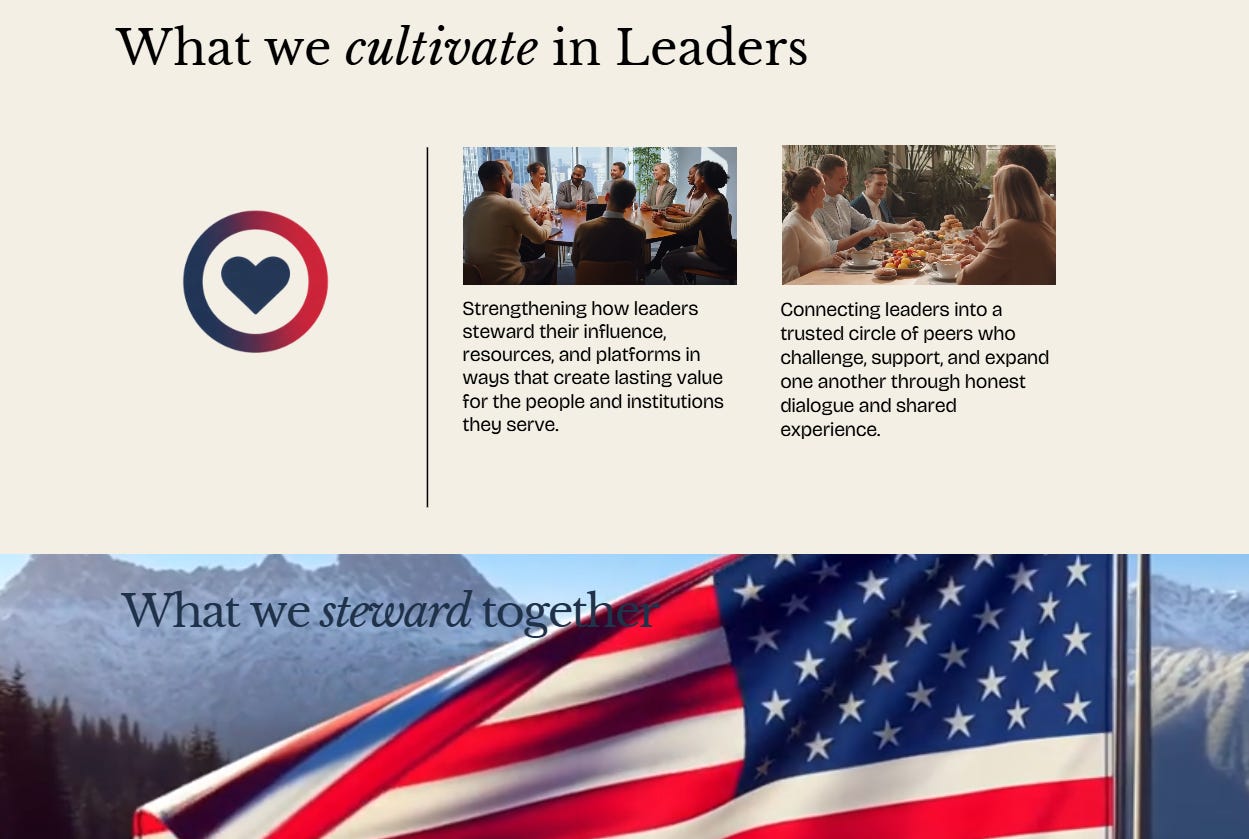
Who is The Healing Alliance? There’s not much info beyond the landing page, which invites you to contact them to apply, but no terms for said applications. The AI-generated flag-draped site invokes patriotic vagueries: “Where Leaders are Strengthened for what they’re called to carry,” or to “become who they are called to be,” to steward “influence, resources, and platforms,” “civic trust,” “cultural and social fabric,” and family, amid three-second stock footage loops of an office meeting, what might or might not be a family eating dinner, and a group of couples walking on what looks like an AI-generated beach. There is no mention of psychedelics or even the oft-preferred euphemism “plant medicine,” and were it not for being looped into an ibogaine non-profit’s press inquiry emails, you would come away with zero guess of what was being healed, or whether it was the alliance that was healing, or whether it was an alliance for healing, or what.
With no response from this extended press triage team besides receiving an AFI marketing newsletter that I didn’t sign up for, I received a response from Hubbard after the week had passed. Most of his answers were printed earlier in this piece.
Another question I asked was, “Your endorsement of Wendi Rees’ book describes America as a ‘New Jerusalem’ that has ‘devolved toward Babylon.’ Do these views inform AFI’s legislative strategy, and were legislators you worked with aware of them?”
In response, Hubbard wrote the following:
Your prior piece on Wendi Rees book falsely asserts that the book recommends the use of psychedelics to impose/facilitate conversion therapy on LGBTQ+ individuals. [Editor’s note—this is false; I wrote, “To be precise, Rees says she does not endorse using these suggestibility-enhancing drugs directly in conversion therapy”]
Given your demonstrated willingness to parlay falsity in your writing for the purpose of producing smear content, I want to be very precise and unambiguous with this answer:
You have repeated my description of America within the book endorsement which you re-frame as “views” without describing how you define, interpret, or characterize those “views” while asking whether those “views” inform legislative strategy or whether legislators are aware of them. Characterizing a description as “views” obviously means you impute some viewpoint content that you don’t specify in your question, viewpoint content that is 100% your own personal supposition informed by your own personal bias. In order to preclude the possibility that you conjure and print an interpretation of the description which conforms to your personal biases, below is a description of viewpoint:
The Opioid Epidemic
The 2008 Financial Crisis which dispossessed millions of Americans from their ownership of the American dream while sending them the bill for the cost of their dispossession.
Twenty-five years of unmerciful warfare, much of it waged with falsity and futility, which has taken exponentially more service members’ lives by suicide here at home than have been lost on battlefields abroad.
The description of America as a “New Jerusalem” which has “devolved toward Babylon” is an indictment of the criminality of official power within the U.S. and the degree to which that criminality has severely damaged the civic morality and underlying social fabric of the society. Over the past 30 years, the criminality of power has created:
Massive government systems are enthroned upon the helplessness of powerless people. They commodify problems they are supposed to solve by monetizing sustained human misery.
The criminality of official power in the United States is gradually imposing a dehumanizing neo-feudalism upon American society which is abusive, extractive, and lethal to a society founded upon the self-evident reality that we are each endowed by our Creator with the unalienable rights to life, liberty, and the pursuit of happiness.
The criminality of power is driving the devolution of American society from one intended to revere individual freedom and dignity to one in which those attributes are subjugated out of existence. This is the devolution of America from New Jerusalem to Babylon. This viewpoint absolutely informs my advocacy strategy and is a viewpoint I share in as many public forums and private conversations as I can, including before legislative committees and with individual legislators.
While I’m still making sense of what’s problematic with the word “views,” for all the words he offers, it’s still hard to discern his full religious perspective when all I can read are star charts from a telescopic view of charismatic branding. The more I interact with his ideas at the only distance I can, it feels like sitting through a PowerPoint with lightning flits between slides showing Good America vs. Bad America, the blood of the fallen, the blood of the Lamb, our shared history, his personal history, the trajected vision, the pain, and the redemption, with flare-ups of snarl (“next slide, thank you,”) transitioning the presentation back to the heart.
I remember the times when I have witnessed street magic, and how even if you keep your eye on the jack of spades picked from the tamper-proof deck, the purpose of getting you to pay close attention to the card is to distract you from where the “magic” happens, which is only possible if the jack is actually real. And if preachers first preach to ourselves, magicians are also their own first audience. Our genuine passion may be the card we focus on to distract ourselves from what we perform for our audiences, and it wouldn’t negate our real desire to deliver something good for them.
In Hubbard’s concluding comment to me, he said, “I have tried to assume your questions have been asked in good faith despite my strong personal reservations to the contrary. The argumentative framing, questionable premises, and presumptuous suppositions contained within the questions reinforce those legitimate reservations. Nonetheless, these responses have been offered fully, unambiguously, and in good faith.”
V. In Performance and In Sincerity
It remains wild that this is an accurate summary: a state representative seems to have admitted to undergoing a federally illegal drug treatment that would seem to be an illegal lawmaker benefit, then publicly cited that as a major influence in crafting a bill that names a non-profit for said drug, whose founder is on a self-appointed divine mission to restore America’s promise as the New Jerusalem.
So the questions that linger for me aren’t just “how do we feel about drug non-profits leveraging the same powers of a corporatized political system behind closed doors that they rail against in the open,” or “how many state representatives are sponsoring psychedelic bills after receiving their own personal undisclosed psychedelic experiences,” or “how much will using the money from opioid harms to fund psychedelic research end up being tragically ironic in the future when more people experience psychedelic harms,” but where will the politics of psychedelic normalization take us next?
Because Rep. Cina didn’t seem to think there was anything wrong here, and that might have been because the treatment apparently had a significant positive impact on his health. I don’t think Rep. Cina is nefarious. However, that’s exactly why ethics rules exist, and why this form of psychedelic educational non-lobbying works.
It’s impossible to know how much undocumented, unofficial, “experiential” advocacy has contributed directly to Western institutions adopting psychedelics, from Harvard affiliates gifting MDMA to their less-experienced colleagues to Johns Hopkins donor-researchers flying out study participants for peyote ceremonies to journalists just “hanging out” with the people they’re supposed to cover. Whether the waves of testimonials land depends on how accurately they replicate the full human picture, or whether they feel like a strange performative simulation of humanity.
I also wonder to what extent Hubbard internalized the lesson learned as a lawyer that power often trumps truth and justice. Did Hubbard learn to fight power with a more rigorous devotion to truth, or to fight political power with the greater power of faith-based persuasion? As reported in The Atlantic, “Hubbard believed ibogaine to be the ideal political candidate for state-funded psychedelics research in general.” Because it didn’t have the baggage of mushrooms or LSD, “I thought there was an opportunity to introduce ibogaine as a blank slate,” Hubbard said.
I wonder about the negotiation between calculation and authenticity when, in the same interview, he tells his origin story not once but twice with almost the exact same beats in the same intonation. I wonder about it again when I listen to his descriptions of the deposition rooms he used to sit in, like in this old interview that Hubbard links to on his personal website:
There were tears in his eyes as he recounted stories of clients he’d met who had been prescribed opioids for work-related disability. He clenched his fists as he described how he saw lawyers, doctors, and government-assistance programs incentivize the prescription of these painkillers. Opioids created an ouroboros of disability for his clients who became more addicted and less able to work and function in the world.
There is something so real about this. But also, what you miss is that the author’s description of “clients” he “met” were clients that were not his clients. He was the guy professionally hired to minimize their claims.
In longer interviews, he describes coming to loathe his “miserable professional existence” and coming to believe that the people he faced (often working-class women in their 40s to 70s) were not trying to scam his companies but were in genuine pain.9 The villains of Hubbard’s stories are not just doctors pushing Big Pharma’s pills, but the attorneys those women hired. But what about the corporations hiring lawyers to give the smallest payouts they can? In a December 2025 podcast, Hubbard described his part of the equation thus: “I enjoyed helping my clients solve problems and the injured worker on the other side get what they needed to have.”
While one may imagine he might carry guilt about his role in this, I was surprised that in the mountains of words I couldn’t find any remorse publicly expressed. If he hasn’t expressed it, that doesn’t mean he doesn’t feel it. In fact, his emotional carriage suggests his empathy was powerful enough to reach across the courtroom. But it’s still a question I can’t answer definitively without speaking for him: does he regret his role in a system that keeps poor opioid addicts in greater poverty? Is there not something potentially tragic about spending a career diverting money from victims of Big Pharma’s opioid crisis as a corporate attorney, only to divert money away from them again for corporate benefit, but now it’s okay because it’s helping pharmaceutical companies research the “divine medicine” of his faith?
As Hubbard told podcasters Theo Von and Aubrey Marcus, there is a “spiritual warfare” between “two sides,” “all of us who can come to recognize that we are of God versus those among us who aspire to be God.”10 “The day of human beings playing God over humans must end immediately.”11 The issue from this Christian’s perspective is not that he sees the cruel machinations of a cold, corrupt system as “playing God.” It’s that if you’re creating a mass corporate system of drugs that you claim connect people to God, that’s also playing God.
The heart of Christian prohibitions against pharmakeia delineates the difference between humans using drugs for medical treatment and humans using drugs to manipulate spiritual forces. It makes sense why the non-Christian psychedelic movement and the industry intentionally conflate the two, because in some ways, the compounds conflate the two. But I wonder if most psychedelic Christians are unwilling to confront that tension honestly because it’s inconvenient to their political project and disquieting to the drug-based experiences they have come to equate with God. Without confronting it, I fear they may be building out the Jesus Inc. floor of a biochemical Tower of Babel.
But I wonder, too, about my own internal stuff here, as someone who talks about God for a living and writes a “candor” blog for nothing. How much of Hubbard’s rhetoric that I recoil against is stuff that people see in me and my rhetoric that I can’t? I wonder, too, whether my motives are ever pure or if I am unconsciously indicted by St. Paul’s ambivalence for ambitious preachers, and how would I know the difference? When I read 20th-century monk Thomas Merton skewering the false mysticism of the spiritualities that undergird the present psychedelic movement, I nod. But when he talks about how often we arrive at our preferred delusions through putting our reasoning in service to our desires, I shift in my seat and feel my head go slightly numb.
My brief interaction with the media performances of W. Bryan Hubbard reminds me of someone I know who went to elementary school with Greg Bovino. They remarked back in January how weird it was that this guy in the news was still a third-grader in their mind. I don’t know anything about Hubbard’s upbringing apart from what he shared, but I know that I didn’t face it, and that someone could look at the kind, middle-class Southern Christians I come from and see us comfortably living off our corrupt systems in ways that compromise our integrity more than those at the bottom. I've been poor as a starving-artist adult, but I have never felt life-threatening poverty. The moral compromises I made in my life have not been out of necessity.
So as disturbing as this whole Western psychedelic project makes me with all its pieces together, because I think it’s ignoring theological wisdom and historical lessons and instead has a self-ordained holy mission to churn through public money to build something that is less about healing than it presents itself to the public…even with all that, I think of the pain Hubbard went through and the life cycles and the attempt to do right by his family, by himself, by his people, by his country, and how the emotions fueling all that may spill out in unpredictable ways, and given who I am and what I’ve done as a sinner in need of grace, who am I to stand as his opposing counsel? I’m stuck in my own uncanny valley. In trying to confront an Eli Sunday, and getting a taste of Daniel Plainview, I fear that I am just another Eli Sunday.
In a follow-up email, I asked him one last thing: “I did have another question that I want you to have a chance to speak to if you’d like. You have a heart for people in addiction that further developed during your time as a corporate lawyer and from witnessing the opioid epidemic unfold. I saw something of it when I did a chaplain internship for a summer at the Asheville VA hospital, an hour from where I grew up. I might have missed it, but I couldn’t find a quote in your interviews I’ve seen about whether you felt personal remorse about working for Walmart, Tyson, and others in fighting the workers’ comp claims of those who, because of their workplace injuries, were led into opioid addiction. Is some of what got you out of corporate law not just seeing what was happening to those caught in addiction, but that it became personally hard to keep doing that work as their opposing counsel? I can imagine that’d be incredibly hard, but if that’s not a fair characterization of how you see your prior career, I want to represent that accurately.”
He did not respond.

6/16 correction — an earlier version said “Growing up in extreme poverty in Virginia as the grandson of coal miners.” More accurately, Hubbard has described his parents and grandparents as having grown up impoverished; he has characterized his own upbringing as emotionally volatile, but I cannot verify his own childhood financial circumstances.
youtu.be/xC-k040TG7I?t=1028 , timestamp 17:08
youtu.be/2DyT2TeX8zM?t=2574, timestamp 42:54
https://www.theguardian.com/us-news/2025/dec/26/us-right-champions-psychedelic-drugs
youtu.be/hyW5b1v3FGw?t=2814, timestamp 46:54
youtu.be/-uwTGfk_sGU?t=3123, timestamp 52:03
youtu.be/2DyT2TeX8zM?t=662 , timestamp 11:02
youtu.be/hyW5b1v3FGw?t=3227 , timestamp 53:47
youtu.be/-uwTGfk_sGU?t=3126 , timestamp 52:06